History of Sardinian language
Language is an extremely important mode of communication that is not always easy to comprehend and historic events are reflected in it. The language that is spoken today by the Sards has undergone many changes, especially because of the various conquests that the island has seen throughout the centuries starting with that of the Phoenicians, followed by that of the Carthaginians who had real difficulty in conquering the island even if, they were not able to conquer the whole of the island thanks to the proud resistance, in particular, of the inhabitants of the plains. 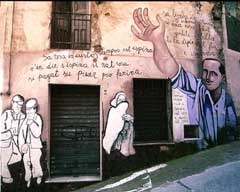
After the Carthaginians came the Romans who conquered the island in 238A.D.
Even the might of the Romans was not enough to conquer the entire territory. In fact their dominion did not reach to the central zones, which they called Barbaria, while the zones they did manage to dominate was named Romania.
The areas that were of major Roman influence were Cagliari and Porto Torres, which saw the evolution of Latin, whilst the areas towards the centre were more conservative. After the Romans came the Vandals, the Byzantines, the Pisans and the Genovese, the Aragons and the Spanish and Piedmonts.
It was with the Pisans that there was a change in language which gave life to the dialect so-named logudorese and campidanese seeing that these areas were culturally and linguistically, while the nuorese-barbaricino remained more closed because the inhabitants of this area were not open to change. It was the political and commercial changes with Pisa that gave rise to an evolution of the Sardinian language.
The influx of the Italian language didn't cease even when Sardinia came under the rule of first the Catalans and Aragons, and then the Spaniards, above all because the young Sards preferred to attend Italian universities of Pisa and Genoa rather than those Spanish.
Sardinia remained under Spanish rule until 1714 and then briefly, until 1718 under the rule of the Austrians, who then gave the territory to Vittorio Amedeo II of Savoy.
Today, the Sardinian language is giving way to Italian even if many expressions and idioms, particularly in the central areas of the island, are still spoken in the original dialect. Many words used by the Sards are clearly of Latin and Spanish origin and certain terminologies of Piedmont origin.
We can see some terms mutated from Latin:
lucerna, a term not widely used but remaining in the term "lugerrai", meaning to dazzle
domu , from the Latin domus, meaning home ;
cinisu from the Latin words cinus, meaning ash;
forru, meaning oven
A term that was used until a short time ago to say hell to people was saludi from the Latin salus. A term taken from pagan divinity: jana meaning witch, taken from the name Diana; and orcu meaning a evil, wicked person.
Terms of Spanish origin are: barduffula spinning-top, ventana window, arretra mouse-trap, a term used by older people is: 'Adiosu' and 'A si biri' from the Spanish adios meaning see you again.


