Geology of Ogliastra
In territorial terms, Ogliastra is divided into six zones of differing morphology:
The volcanic mountain of Monte Ferru in Tertenia: situated in the south of Ogliastra is in part of one of the many protected zones of Sardinia for its unparalleled beauty. It is a wide mountain range dotted with valleys which witnessed massive volcanic activity towards the end of the Palaeozoic era.
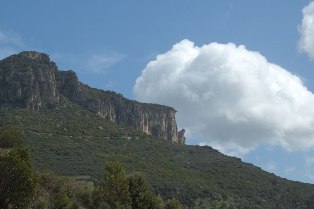 The scission-metamorphic valley of Pardu-Pelau (Cardedu) is characterised by the various types of erosion, in particular the undermining caused by water in the lower parts of the slopes and in the areas of high inclination.
The heels of Jerzu and Osini are highland plains of chalkstone that are found in the north-occidental area. Their origins are of a complex process that began in the Mesozoic era from the accumulation of arenaceous, chalk and dolomite debris that were present in shallow waters and sequentially emerged from the waters.
. Imposing banks of chalkstone and dolomites were formed. Because of the eroding process of the water, simple plains were sculptured such as those found in Jerzu, Osini and Ulassai. In the part between the "heels" and the Supramonte d'Orgosolo granite formations can be seen. Theoretically it is thought that these were formed during the phases of covering of the land which began in the north and north-eastern territories (Gallura, Corsica).
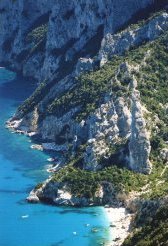 The batholitic granite formation : derives from the solidification of intrusive or plutonic rock, it hs the form of a dome or a hemispheric mass that widens at its base. In Ogliastra, the most common example is the biotope, thus the granite is that of fairly large grain and of grey colouring. Among the biotitic fissures lodes can be seen, well formed crystals of notable dimensions. Those most commonly found in this region are the hoplites which vary in their colouring of white, yellow and pink.
The jar of Teccu in Barisardo, an area created by the volcanic activity of Monte Ferru during the Tertiary or Cainozoic era. The jars were formed following a continuous out flowing of lava from the fissures of the crust rather than from one particular font. Covering the surrounding terrain, it gave birth to fairly thick basaltic plateaus. The basalt present in this area is of a dark grey with intervals of red-black.
The coastal plains of Tortolì, Lotzorai, Girasole, Barisardo and Cardedu complete the countryside of Ogliastra. These plains are fertile and cultivated marked with streams and rivers. There are dark alluvial deposits dating back to the late Plesiozoic era, and deposits of red pebbles from the earlier part of this same era.
The plains of Lotzorai are dominated by rare hilly formations similar to inselbergs that never reach over the height of 100m, while towards the centre of the village, there are deposits of granite pebbles.


