Archaeological sites in Ogliastra
Sites to see in Ogliastra:
.jpg) Lotzorai Archaeological Park - Necropolis with domus de janas
Lotzorai Archaeological Park - Necropolis with domus de janas
How to get there: from Lotzorai, take the road for Talana. You will find the tourist signposts to reach the area. Around 10km from the village.
It is a Necropolis containing at least 17 domus de janas upon the hill of Tracucu. Some excavations have unearthed fragments of pottery and 3 complete earthenware jugs. The necropolis was built during the late Neolithic Era, but was also used during the Bronze Age. The tombs are both mono-cellular and multi-cellular with entrance corridors reaching up to 5m in length. A nuragic complex is situated on the summit of the hill, from which you can admire the entire surrounding countryside.
Villagrande Archaeological Park
How to get there: situated in the zone of Genna Traculu, beside Lake Flumendosa and the area of S'Arcu 'e Is Forros, to the south of the Corr'e Boi Pass. Guided tours.
There are various archaeological sites in the territory of Villagrande as it is situated in a vast mountain range. Close to Lake Flumendosa, you can see a number of giants' tombs dating from the Bronze Age. This site was dismantled and reconstructed close by to avoid its destruction during the building of the SS389 Villagrande - Nuoro motorway. Near the second archaeological site, close to the Corr'e Boi Pass, an ancient homestead has been discovered. A unique example in Ogliastra, it is a Megaton temple with 4 cells, perhaps dedicated to the Water Cult. According to the numerous excavations, the temple dates from the Bronze Age.
Lanusei Archaeological Park
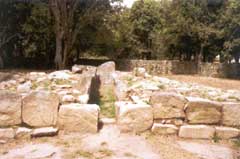 How to get there: from Lanusei, follow the signs for Bosco Selene. Guided tours.
The archaeological site is found within the great oak wood that dominates the area. It is made up of a nuragic tower (of which only the foundations remain), around 200 ancient huts that constituted the village, and 2 giants' tombs. These tombs date from between the 15th and 14th centuries BC: the first is smaller, semi-circular with a corridor for burials. The second is larger and better preserved, and is particular for its 3 pierced stones that were originally found at the entrance. According to experts, these stones represented fertility.
Osini Archaeological Park
How to get there: follow the SS125 towards Osini, passing through Jerzu and Ulassai. Follow the road that crosses the chasm of San Giorgio and towards the high plains.
The Nuragic complex of Serbissi, a nuragic "tholos" tower and a dwelling of huts dating from the Bronze Age. The central tower is surrounded by three lesser towers. At a height of 6.30m and on two floors connected by helicoidal stairs. One particular is the cavity under the tower, perhaps used by the inhabitants to keep foodstuff. The towers of Sanu and Orruttu are close by and are characterised by their mono-tower design and flanked by giants' tombs and a hut.
Tortolì Archaeological zone of San Salvatore
How to get there: from Tortolì, follow the southern exit for Cagliari and the indications for Lido di Orrì. The site is found close to the small rural church of San Salvatore.
To the right, upon the hill you can admire the remains of a nuragic tower that dominates the plain. At the base of the tower there are circles that give evidence of the presence of a nuragic village. Nearby, there is a domus de janas (an burial place in the rock-face), a giants' tomb (megalithic burial ground), and two menhir.


